
The Ultimate Gym Flooring Guide for South Africa (2026)
Why flooring is the most under-budgeted spend in a gym
Members judge a gym in their first 30 seconds — and the floor is what they see and feel first. But flooring also does five jobs no other single spec has to do: protect the concrete, protect the equipment, absorb impact, quiet the noise, and grip under sweat. Get it wrong and you're replacing tiles, refunding downstairs tenants, and voiding equipment warranties.
This guide compares the four floor types we install in South Africa, the thickness for each training zone, and what it should cost per square metre in 2026.
What are the four gym flooring types?
Rubber tiles
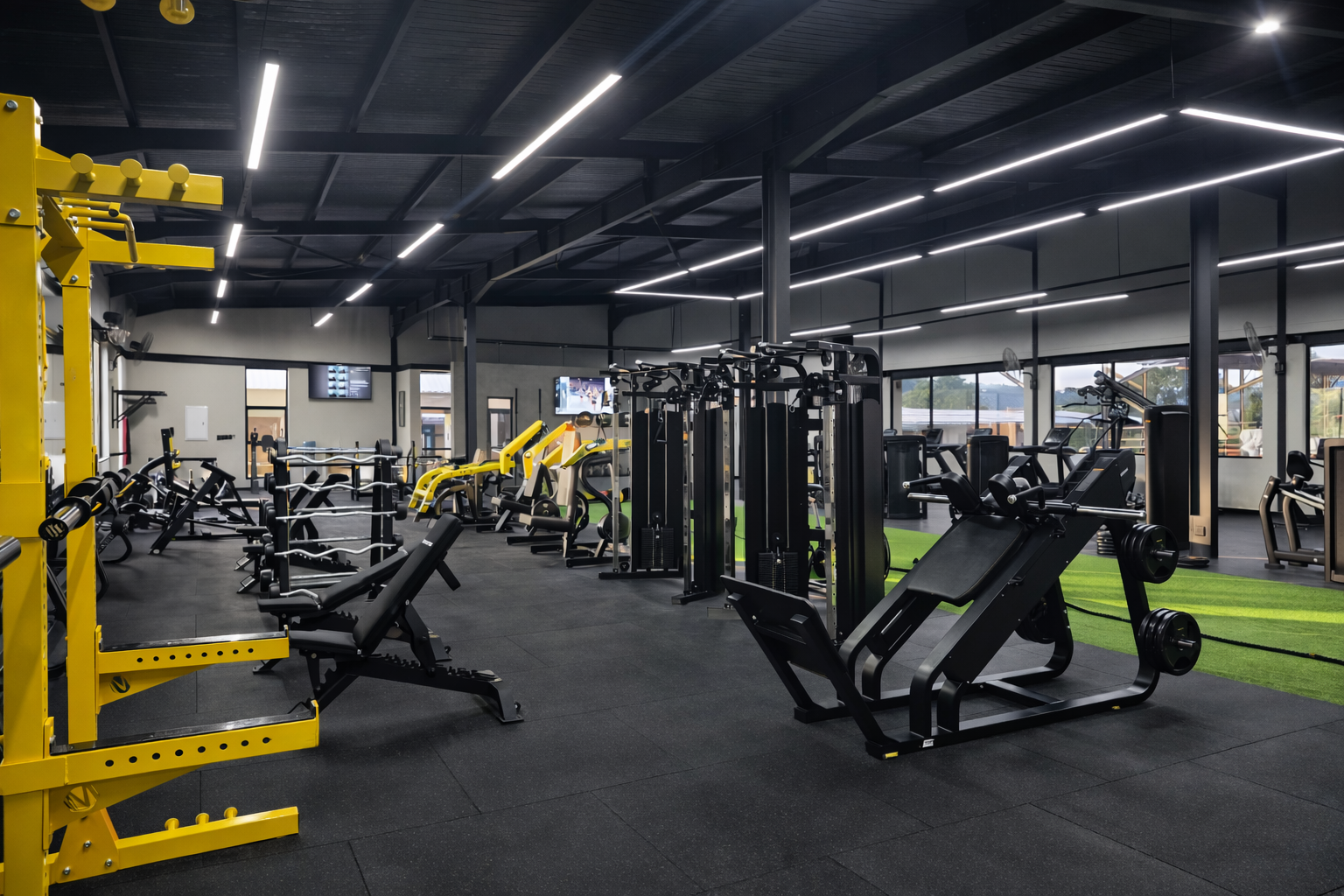
Recycled rubber granules bonded with polyurethane, sold as 1m × 1m tiles or rolls.
- Thickness: 15mm (light strength), 20mm (general commercial), 30mm (drop zones and platforms), 40–50mm (Olympic lifting)
- Best for: free weights, dumbbell racks, power racks, deadlift platforms
- Colours: black is default; blue, red, yellow and grey speckle available
- Sound absorption: excellent — a dropped 20kg plate reads roughly 65dB on 20mm rubber vs 90dB on tile
PVC interlocking tiles
Rigid PVC tiles that snap together, usually 50cm × 50cm.
- Thickness: 5–10mm
- Best for: group fitness studios, walkways, functional areas without heavy drops
- Advantages: fast to install (no adhesive), individually replaceable, water resistant
- Limits: not rated for drops above 20kg from waist height
Artificial turf strips
UV-stable artificial grass with a heavy backing, sold as 2m or 5m wide rolls.
- Best for: sled push tracks, prowler work, agility drills, functional zones
- Length: 8–15m strips run down the side of a commercial gym
- Install: laid over rubber underlay for shock absorption; edge-taped, no adhesive
Foam interlocking tiles
Soft EVA foam tiles, 10–25mm.
- Best for: kids' zones, yoga corners, light stretching
- Never use for: any dropped weight, cardio machines, or heavy foot traffic
- Foam compresses permanently under machine loads inside a month
How thick should the floor be?
Thickness is dictated by what happens on top of it, not by budget:
| Zone | Recommended thickness | Material |
|---|---|---|
| Reception, walkways | 5–8mm | PVC or LVT |
| Cardio floor | 8–15mm | Rubber or PVC |
| Selectorised strength | 15mm | Rubber |
| Free weights / dumbbells | 20mm | Rubber |
| Deadlift platforms, drop zones | 30–50mm | Rubber (or bumper + platform) |
| Olympic lifting | 50mm + wooden platform insert | Rubber base |
| Sled / functional strip | 15mm rubber underlay + turf | Turf over rubber |
If members will drop weights, 30mm rubber is the honest minimum for warranty protection on your equipment.
What does gym flooring cost in South Africa?
2026 pricing benchmarks (supply only; installation adds R60–R120/m²):
| Material | Thickness | Price/m² |
|---|---|---|
| Rubber tile | 15mm | R220–R290 |
| Rubber tile | 20mm | R290–R360 |
| Rubber tile | 30mm | R360–R450 |
| Rubber tile | 40–50mm | R450–R650 |
| PVC interlock | 8mm | R180–R280 |
| Artificial turf | strip | R220–R320 |
| Foam tile | 20mm | R80–R160 |
For a typical 300m² commercial floor with mixed zones, budget R70k–R110k supplied and installed.
Installation — what actually matters
- Subfloor: concrete must be dry, level within 3mm/m and free of oil or curing agents
- Acclimatisation: rubber tiles need 24–48 hours in the room before installation to settle to temperature
- Adhesive vs loose lay: 20mm+ rubber tiles are heavy enough to lie loose; adhesive is only needed in high-traffic entryways or drop platforms
- Edge trims: use aluminium or bevelled rubber transitions where flooring meets tile or carpet — exposed edges lift within months
Attempting a DIY install on anything above 200m² usually costs more in wasted tile than professional installation would have.
Noise, drops and multi-tenant buildings
If you're on the first floor of a mixed-use building, your neighbours will call your landlord. Two rules from projects we've done in Sandton and Cape Town CBD:
- Never train barbell lifts on flooring under 30mm, even if the concrete is 250mm poured slab.
- Build a drop platform — 50mm rubber base + horse-stall mats + 20mm plywood — for any deadlifts above 100kg.
A properly built drop platform absorbs 90%+ of low-frequency impact energy; a bare rubber floor absorbs 50–60%.
How to spec flooring for a home gym
For most home setups:
- Garage on ground slab, single lifter under 100kg: 20mm rubber tiles, loose laid, over the whole training area
- Wooden floor upstairs: 30mm rubber under a 20mm plywood platform in the drop zone; 15mm elsewhere
- Cardio only: 15mm rubber or 8mm PVC is enough
Getting it right
Send us your gym drawing or a rough sketch and we'll spec flooring zone by zone, priced in ZAR and delivered nationwide. Start on Gym Solutions or browse the flooring collection directly.
Frequently Asked Questions
Need Expert Advice?
Our team can help you spec the right equipment for your space and budget — with delivery, installation and finance across South Africa.