How to Set Up a Commercial Gym in South Africa (2026 Guide)
Is a commercial gym still a smart business in South Africa?
Short answer: yes, if you plan it like a business rather than a hobby. Gym membership in South Africa has recovered past 2019 levels, and demand for boutique, functional and 24-hour formats is growing faster than the mainstream chains. What has changed is member expectations — cleanliness, equipment quality, and a specific training format now decide whether people renew.
This guide walks through the six decisions that make or break a commercial gym: location, layout, equipment, budget, compliance and staffing. Everything below is based on real South African fit-outs, not imported US or European benchmarks.
How much space do you need for a commercial gym?
Space drives every downstream cost — rent, aircon, flooring, insurance. Rules of thumb we use on every project:
- 8–12m² per concurrent member at peak hour is comfortable
- 200m² is the practical minimum for a full-service commercial floor
- 500m²+ unlocks separate cardio, strength, functional and stretch zones
- Ceilings should clear 3m; 3.5m if you plan rope climbs, overhead pressing platforms or aerial rigs
Add roughly 20% of the training floor as back-of-house — reception, change rooms, ablutions, office and storage. In leased space, always confirm floor loading (kN/m²) before installing squat racks or heavy plate stacks.
How do you zone the training floor?
Zone the floor before you buy equipment. A good layout guides members through a natural training flow and keeps noisy zones away from studio classes.
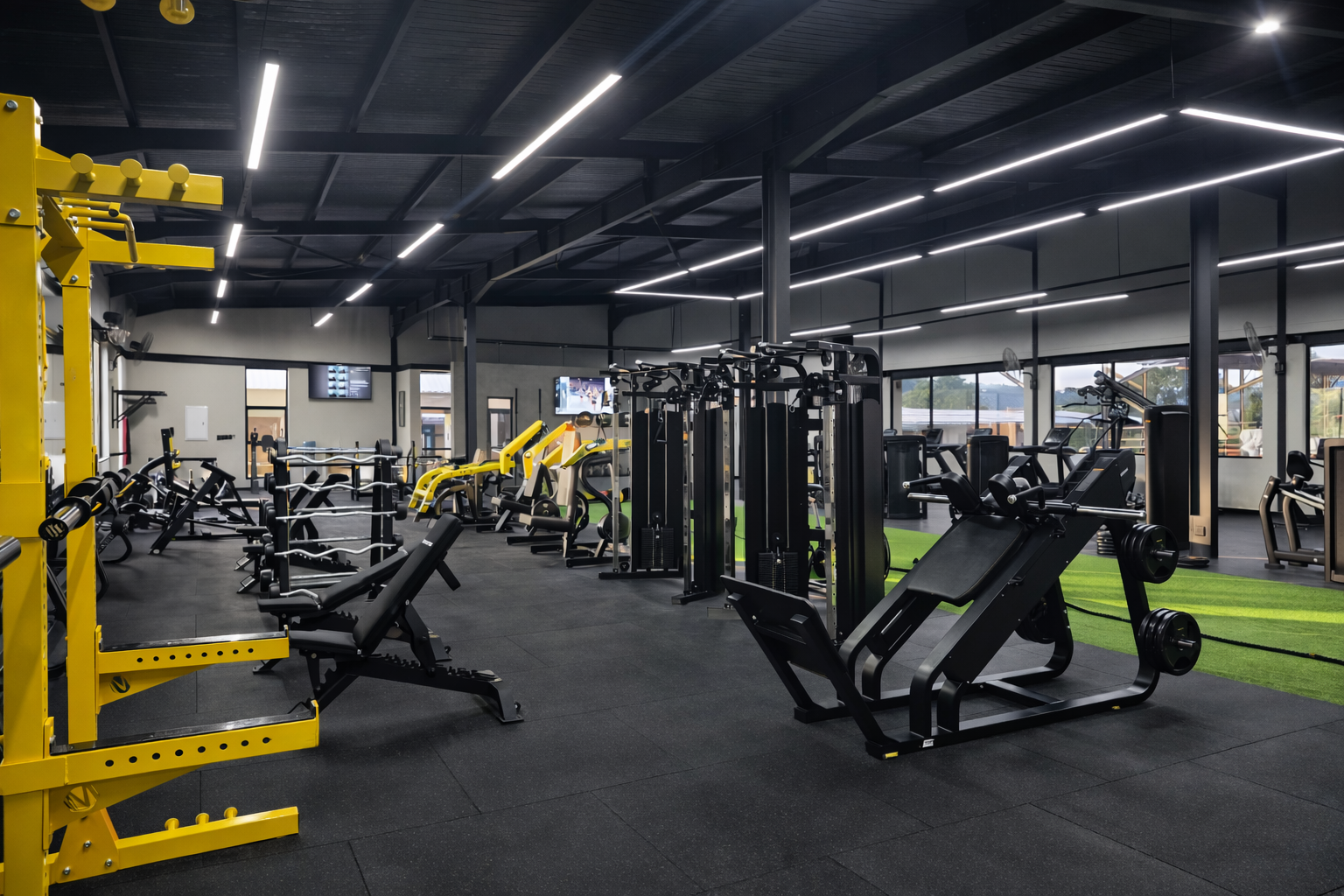
A proven mix for a 300–500m² commercial floor:
| Zone | Share of floor | Purpose |
|---|---|---|
| Cardio | 30% | Warm-ups, steady-state, HIIT |
| Strength (machines + free weights) | 40% | Barbells, racks, plate-loaded, selectorised |
| Functional / turf | 20% | Rigs, sleds, kettlebells, mobility |
| Stretch, recovery, ancillary | 10% | Mats, foam rollers, boxing bag |
Keep drop zones (deadlift platforms, kettlebells) on the perimeter, away from mirrors and glass. Position cardio to face a window or screen bank — members stay on the machine longer when there's something to look at.
What equipment do you actually need to open?
You do not need everything on day one. Members punish gaps in the basics far harder than they punish missing extras. Cover this before opening:
Cardio (30% of floor)
- 3–6 commercial treadmills with 15% incline and 4.0+ HP motors
- 2–4 indoor cycles for classes and HIIT
- 2 recumbent or upright bikes for lower-impact members
- 1–2 rowers, 1 stair climber if space allows
Strength (40% of floor)
- 2 half racks or a full rig with pull-up stations
- 2 flat, 2 adjustable and 1 decline bench
- Olympic bars (20kg + 15kg women's), bumper plates 5–25kg pairs, iron plates 1.25–20kg
- A full rubber hex dumbbell rack from 2.5–40kg
- Selectorised chest press, lat pulldown, leg press, leg curl/extension, cable crossover
Functional (20% of floor)
- Wall-mounted or freestanding rig with attachments
- Kettlebells 8–32kg pairs, medicine balls, plyo boxes, battle ropes, sled + turf strip
Recovery + accessories (10% of floor)
- Foam rollers, yoga mats, resistance bands, stretching cage or bench
Browse the full range in our shop or ask us for a zone-by-zone quote against your floor plan.
What does a commercial gym cost in South Africa?
Real-world 2026 numbers from projects we've completed:
| Format | Size | Equipment budget | Fit-out total |
|---|---|---|---|
| Boutique / studio | 100–200m² | R250k–R600k | R500k–R1.2m |
| Neighbourhood gym | 200–400m² | R600k–R1.5m | R1.2m–R2.8m |
| Full-service commercial | 400–800m² | R1.5m–R3.5m | R2.8m–R5m |
| Franchise flagship | 800m²+ | R3.5m+ | R5m+ |
Equipment is typically 55–65% of total fit-out spend. The rest breaks down roughly as: flooring 8–12%, mirrors and finishes 5–8%, HVAC and electrical 10–15%, signage and reception 3–5%, contingency 5–10%.
Which regulations and compliance boxes matter?
Get these signed off before you sign a lease:
- Zoning — confirm the property is zoned for a gym or health studio with the local municipality.
- Occupancy certificate — required before you can trade; the landlord's approval isn't enough.
- Fire compliance — emergency exits, extinguishers, escape lighting, and a fire officer sign-off.
- POPIA — you'll store member data, biometrics and health disclosures; register a data information officer and publish a privacy policy.
- Music licensing — SAMPRA and CAPASSO cover recorded music in commercial spaces; without both, you're liable per class.
- Public liability insurance — R5m minimum cover is standard.
- Trainer qualifications — all coaching staff should be REPSSA-registered.
How should you staff the opening?
Understaffing at launch kills renewal rates faster than any equipment gap. Minimum viable roster for a 300m² gym:
- 1 manager (also handles sales and retention)
- 2 floor trainers on rotating shifts
- 2–3 class instructors on contract
- 1 cleaner morning and evening
- A part-time bookkeeper or outsourced accounting
Budget salaries and contractor fees at 25–35% of monthly revenue once you're trading.
How do you finance the equipment?
Cash is rarely the best option, even when it's available. Spreading equipment cost over 24–36 months preserves working capital for marketing, staff and the inevitable first-six-months curveballs.
We arrange equipment finance through our finance partner, on either a business route (registered business trading 3+ years) or an individual route (salaried applicants earning R45 000/month or more). Deals range from a single rack through to a full commercial fit-out. Current criteria and the application are on our finance page, and our finance guide explains what to prepare.
Ready to plan your gym?
We offer a free 3D layout service — send us your floor plan, and we'll come back with a zoned drawing, equipment list and a firm ZAR quote inside 48 hours. Start on Gym Solutions or browse our full equipment range.
Frequently Asked Questions
Need Expert Advice?
Our team can help you spec the right equipment for your space and budget — with delivery, installation and finance across South Africa.